Monday, March 31, 2014

James and Ketiran Thornton

Yesterday I was working on my article about William Thornton, who I believe to be my 4th great grandfather.  His parents are said to be James and Elizabeth Jenkins Thornton.  Nothing is known about Elizabeth other than her name.  In 1740 when James sells some land in Massachusetts his wife had to cosign the deed.  She was unable to write so some else wrote her name down and she made her mark.  Her name was the very unusual Ketiran.  Elizabeth had presumably died and James had remarried.

I was playing around with lists of children and came up with the following:

maternal father         maternal mother  mother
paternal father          paternal mother   father


Matthew/Hannah Jack (Andrew&Mary)Agnes/John WasonWilliam/Dorcas Little (Thomas & Jane)
William/ Elinor Unknown
Hannah/William Wallace (John&Annis)Ester/James Ferguson
JamesCatherineWilliamMaryMary
AndrewThorntonJamesJohnEster
MaryJamesMatthewWilliamMargaret
HannahGeorgeMaryCatherineHannah
MatthewThomasThomasJamesRobert


JohnHannahJames


SamuelMatthew


Abraham


Catherine


Sarah


Dorcas (d/o elinor)


Eleanor


Okay, so in colonial times, many people used very distinctive naming patterns for their children. The first son was usually named for the father's father, the second son for the mother's father.  The first daughter was named for the father's mother and the second for the mother's mother.  Then the parents would name children after themselves.

If the children of James Thornton all shared the same mother and her name was Elizabeth, her name is conspicuously absent. Each of James' children named a son James.  Most of the children named a child for themselves and their spouse.  Only William named a daughter Nancy, said to be the name of their grandmother Thornton. (Error note: William did not have a daughter named Nancy, this was a transcription error)  There were four daughters named Mary and three named Catherine.  Agnes named her first daughter Catherine.  What if Ketiran was really a mangled spelling of Katherine?   This makes a lot of sense to me.

Unlike these days when all manner of made up names are used, the folks of the 18c. used well known names. Ketiran is not a name seen anywhere else.  What do you think?

_______________________________________________________________________________

NEWS FLASH 24 July 2015: I have found some new information on Katherine Thornton!!!

Yesterday I was reading the deed of sale in which James Thornton's wife was named. Her name was listed three times, in the space of four or five lines. Each time the name is spelled differently. Here they are:


I think that it is pretty clear from the first two instances, her name was Katherine. Only in the last one is it spelled Ketiran.  I have run these three names by many people and they all agree that the intended name must have been Katherine. I also believe that it is highly likely that the mother of at least some if not all of James' children was Katherine. If Katherine was not their mother, then I would put a bet on the Mother's name being Mary. The total lack of grandchildren named Elizabeth, is to me, a strong indication that James' wife was not an Elizabeth.

Okay! Found her name once more in a deed and I think this one, if you aren't already convinced, will seal the deal.


Thursday, March 13, 2014

My Honored Father, William Thornton

My grandfather, Paul Thornton, was a great lover of history.  He had a copy of Charles Thornton Adams biography of Matthew Thornton and his family. Matthew Thornton was a doctor, soldier, statesman from the Colony and State of New Hampshire.  This has always been a point of pride for our family, our connection to the American Revolution. I believe that the book may have originally belonged to my great grandfather John Clark Thornton, I have it now.  He, John, is mentioned in the book as a descendant of Matthew's brother Samuel Thornton and he attended meetings of the Thornton Family Association in Boston along with his first cousin Dudley Clark Thornton.  

The Thornton line went from John to Samuel (3), Samuel (2),  Samuel (1) to James Thornton, immigrant. Matthew, the third child of James and Elizabeth Thornton, is said to have been born in Ireland around 1714. Samuel was the sixth child and fifth son and is said to have been born after their immigration to the new world, 1720 is usually thrown out as the year of his birth. His place of birth is said to have been possibly in Wiscasett, Maine. His death too is uncertain said to be around 1798. A cloud of uncertainty seems to hang over Samuel, but my genealogy motto is; if it was easy, it wouldn't be any fun. I am gonna find this guy.

Starting with the Adams manuscript, I know that Samuel was married twice and had 22 children, eleven by each wife.  The names of his two wives are of course unknown as are the first set of eleven children.  The second set of children are: Samuel (2), Reuben, Sarah, Abraham, Catherine, Dorcas, Eleanor, William, Sumner, Hannah and one unknown. Samuel was born in 1775 and Dorcas in 1779, both in Thornton, NH. The date of birth for the remainder of the children is not known. I know records are often missing or incomplete but how do two wives and 20 children disappear from any records. (FYI if you think Samuel Thornton married Mary Ann Craven in Maine, you are wrong. That marriage took place in 1878)  So, the question is where to start looking for Samuel and his gang of offspring.

If Samuel was born in America, then he must have spent the first twenty or so years of his life with his father. A search of the history of Pelham, founded by his father, shows that he was there at least until 1746, when the town paid him for some work he had done on it's behalf. That's all for Pelham. There is no record of a marriage or children taking place there.  That doesn't mean it didn't happen, just that no record survives. Where to look next.

Again, turning to the manuscript, Adams tells us that Samuel lived in both Campton, NH and Hatley, Stanstead, Quebec, Canada. I have read through the Campton, NH records and there is no Samuel paying taxes there prior to 1798. Hatley, Canada was founded sometime after 1790.  In the book, "Forest and Clearings", a history of Stanstead and genealogy of the first settlers, there is no mention of Samuel. The land was covered by a vast forest and the work of turning it into farmland was arduous.  If Samuel was an early settler in Hatley he would have been over 70 years old. This seems a bit much, even if he was in the best of health, for a man of his age.

Geez, this is harder than I thought, Samuel (1) seems almost nonexistent and Samuel (2) seems to have sprung right out of the ground. A search of other family trees on Ancestry.com and other websites reveals that a large number of people seem to believe that Samuel (1) left New England for the South.  Many trees have him in Abbeville, South Carolina married to a Mary Simonton. This Samuel died in July of 1797. Hum.

Meanwhile, I decided to hook up with the DAR (Daughters of the American Revolution).  In the process of looking for ancestors I have found a ton who have the qualifications for a DAR patriot. When I met with the Registrar I told her I wanted to use my ancestor Enoch Rowell as my patriot. After looking at my tree and at her DAR records she said, "nope it would be way easier to use SAMUEL THORNTON". What!!!! I mean, what does the DAR know about Samuel that I have been unable to find.

The DAR records say that Samuel (1) lived in Lanesborough, MA and served in the militia.  They have a land deed for him dated 1790. I'm not so sure about this story either.  I tried to track down this Samuel.  It seems that he had a brother Benjamin who also lived in Lanesborough, as well as two daughters, Ann and Bathsheba.  Nothing about this sounds right.  Bathsheba, surely if Samuel had a daughter with that name, someone would have remembered it.  Hum, further research shows that this Samuel left Lanesborough and moved to New York sometime after 1790.  I don't think this is my guy. A lot of ancestry.com members don't think so either.  They think he is one of those Rhode Island Thorntons. (still, he got me into the DAR)

That's it. I'm tired of Samuel (1), he doesn't play fair.  I decide to concentrate on Samuel (2) and the rest of the Thorntons.  I know that Samuel (2) and his wife Katherine Baker were married in Campton in 1802 according to the Adam's Manuscript.  I search the 1800 federal census and there he is, living in Campton. Also in Campton is John Durgin, future husband of Samuel's sister Dorcas.  Yea a small victory, but not much more. I decide to run down the Bakers, Katherine's folks.

Katherine's father was Benjamin Baker.  He and his brothers settled in Campton, NH after the war. His brother Moses Baker was a fairly well to do guy who was very involved in town business. Benjamin died in 1790 when Katherine was only 11.  I checked the probate index to look for Benjamin and in doing so I noticed that a William Thornton of Thornton, NH also died in 1790. According to the index he left a widow and three small children under to age of 14.  The names of the wife and children really caught my eye.  They were: Abraham, Catherine, Sarah and Eleanor.

Remember the list of Samuel's (1) children:  Samuel, Reuben, Sarah, Abraham, Catherine, Dorcas, Eleanor, William, Sumner, Hannah and unknown. The wheels are churning now.  What if Samuel and Dorcas were the children of this William as well. William was the forth son of James Thornton and if Matthew was born in 1714 then William was probably born around 1718-1722. He married in Pelham, MA and then moved his family to Dublin, NH.  Supposedly the family left there because of Indian raids and joined his sister Agnes Thornton Wasson in Schenectady, NY.

William and his wife, supposedly Dorcas Little (another name on my list),  raised his first family in New York, their children included William Jr., John, Matthew, James, Molly and Thomas.  William is also on the list of Samuel (1) supposed children.  William (1) and his sons William (2) and Matthew returned to New Hampshire prior to the start of the American Revolution. His wife, Dorcas, died in 1763, and it seems he remarried either right before he left New York or just after he arrived in New Hampshire. I wrote a blog post about my theory that William might be the father of Samuel (2) and Dorcas, but I couldn't find any proof.

Do I give up, no way, I am nothing if not dogged in my pursuit of father of Samuel (2), no way am I throwing in the towel on this one.  So, last week there I was eating my lunch at work and doing a little ancestor digging as I munched through my Lean Cuisine.  I was on famlysearch.org (great site if you know how to really use it) checking to see if I could find Samuel (1) probate records.  I was looking at Grafton County and choose the records from 1798, the year many say he died.  Gee, there's only 1100 pages of probate records to dig through, these record have not been indexed so it's a real slog to get through them.  I start jumping through the records looking for the name Thornton and finally serendipity strikes.  I click on a page and what jumps out at me, three signatures: Samuel Thornton, Dorcas Thornton and William Thornton.  Well, well, well, what do we have here!

What I have stumbled into is the 1798 probate of the estate of William (1) Thornton.  Although he died in 1790 his estate was never probated.  His wife Eleanor was made his executor in 1790 right after his death. Then in 1797 or 1798 she remarried, her new husband was Benjamin Avery.  The probate court then made the decision to appointed a new administrator of the estate and proceed with probate, and this brings me to the document which clinches the deal. The job was offered to William's son who declined to accept the role of administrator. The son writes,
This may certify that I have no desire to administer on the estate of my honored father, William Thornton witness my hand.  Samuel Thornton.

Yippee Ki-Yay!  Samuel Thornton was the son of William Thornton. On another page the court records all the debts against William's estate, this is signed on the back by his heirs, William Jr, Samuel and Dorcas Thornton.

Rather than be the end of this journey, it's only the beginning of another one, the pursuit of William Thornton. I can only hope he is as great a challenge than his brother Samuel.  So what happened to Samuel, maybe he did end up in South Carolina.

Are you a Thornton Cousin?  I'd love to hear from you, I am working on a family tree of all the descendants of James Thornton.

Related Posts:
James Thornton


Thursday, March 6, 2014

Samuel Thornton son of William Thornton, my Thornton Family Breakthrough

Today is a great genealogical day for me, possibly the best.  I have been struggling with my Thornton ancestry almost from the beginning.  According to everything I have read, my Thornton line descends from James Thornton, father of Matthew the signer of the Declaration of Independence, through his son Samuel. The line went:  James, Samuel (1), Samuel (2), Samuel (3), John, Paul, my father. My problem was finding any kind of documentation on Samuel (1). In one of my many posts on my Thornton ancestors I speculated that the real father of Samuel (2) was not Samuel (1) but rather his brother William.  Today, I believe that I have found the documents which prove this relationship.

While looking at the probate records from Thornton, New Hampshire, I checked the probate of William and there it was.  The document was one in which the heirs of William Thornton acknowledge receipt of something or other and it was signed by William's children: Samuel, Dorcas and William. Dorcas, who later became Dorcas Durgin, has long been believed to also be a child of Samuel (1).  Yipee! Samuel is the son of William. 


I will, of course, be posting much more about this discovery, but I was so excited by this finding that I had to put it into writing immediately.  

Tuesday, March 4, 2014

Thornton DNA Project

A few months ago I submitted a YDNA kit from my father to familytreeDNA.com for testing.  I have been anxiously awaiting the results and they have finally arrived. We are descendants from a race of space aliens with a superior intellect. Actually we are just what I thought, a bunch of Brits, recently transplanted to the North American continent. 
Our haplogroup is R1b1a2, this group is found predominantly in France, England, Ireland, and Wales. In a comparison chart on the website of all Thornton's who have had their YDNA tested we fall into a unmatched category.  Interestingly, the Thornton's in Virginia and other southern states are mostly of a different group, I1 which ended up in Scandinavia. 
What I need is for Thorntons who claim descent from James Thornton of Ireland, the father of Matthew Thornton, signer of the Declaration of Independence, to have their DNA tested. There are some southern Thorntons who claim descent from Samuel Thornton, son of James, and brother of Matthew.   They think he migrated to the south and lived in South Carolina.  This is the same Samuel who we say is our ancestor and that he lived in New Hampshire with the rest of his family. 
A DNA test will not give you a list of ancestors but it can point you in the right direction.  If a southern Thornton thinks they're are part of the New Hampshire family a DNA test could prove it.  If you are a Thornton and have a few spare dollars, the Thornton DNA project could sure benefit from your DNA test.


Related Posts:
James Thornton
Samuel Thornton

Sunday, February 23, 2014

Valentine Rowell of Mancetter, England and Salisbury, MA

english origins
Valentine Rowell was the son of Thomas and Margaret Milner Rowell. He,presumably named for his Grandfather Valentine, was baptized 22 June 1622 in Mancetter, Warwickshire, England. He traveled with his father to America. None of his siblings made the crossing. 

salisbury 
Valentine like his father was a carpenter by trade. He settled in Salisbury with his father. He was granted lands in 1640, in the original division, and his name appears on the list of admitted "townsmen" in 1650. He too, bought and sold land during his lifetime. Although he took the oath of fidelity in 1646 he never took the Freeman's Oath, nor did he become a full member of the church. 


his wife joanna
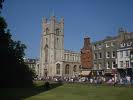
St. Mary's Cambridge
Joanna Pinder was the daughter of Henry and Mary Rodgers Pinder of Ipswich. It is not known when Henry Pinder came to America but he presumably came by 1635. His wife and children came in the boat the "Susan and Ellen" in 1636, Joanna was then fourteen years of age. Henry Pinder was born about 1580 and was married to Mary Rodgers at St. Mary the Great in Cambridge, England on 22 May 1614.   Henry lived in Ipswich until his death in February 1661.  His wife Mary died sometime before 1655 and he remarried the widow of Robert Andrews. Joanna and Valentine, both aged about 21, married in Salisbury on 14 Nov 1643.

children of valentine and joanna, all born in salisbury
Thomas b. 7 Sept. 1644, m. 8 Sept. 1670 Sarah Barnes, d. 1684
John b. 1645/6, d. 1649
Philip b. 8 March 1647/8, m. 5 Jan 1670/71 Sarah Morrill, d. 7 July 1690 killed by Indians
Mary b. 31 Jan 1649/50, m. 18 Sept. 1673 Thomas Freame, d. Unknown
Sarah b. 16 Nov. 1651, m. 26 Oct. 1676 Thomas Harvey, alive in 1716
Hannah b. Jan 1653, m. 16 Sept. 1674 Thomas Colby, d. 9 Aug 1707
John b. 15 Nov. 1655, d. 18 Feb 1655/56
Elizabeth b. 10 August 1657
Margarite b. 8 Sept. 1659

At least two of their children died very young, both sons named John.  Nothing is known of the last two children, both girls, other than their births. In March of 1673, their daughter Mary and Thomas Freame were accused of having premarital sex and sentenced by the court: he to a whipping of 15 lashes and a fine of 4 pounds and she to 10 lashes and a fine of 40s.  To avoid their punishment, they choose to marry. 

amesbury
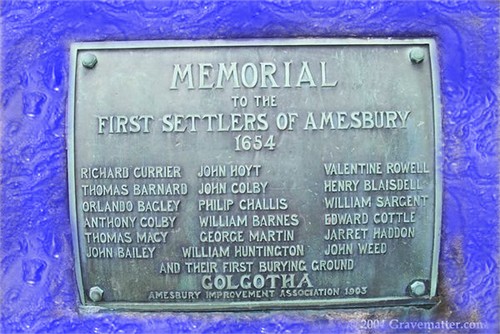
In the mid 1640's settlers began crossing the river Powwow and building home sites there. Eventually it was decided that the town would be divided and a new town called Amesbury would be established.  Valentine Rowell was one of the first settlers to establish the new town.  On the "first of the third, 1655" Valentine signed an agreement to remove to the new town.  In May of 1658 he received 40 acres of land. The map, below, from the 1800's gives you and idea about the location of Salisbury, the Powwow river and Amesbury.


Valentine does not appear to have held any town offices, he is most often mentioned in land deeds and conveyances. His son Thomas received land in Amesbury in what was known as the Children's lot, one child from each family was allow land in that division.

rip
Valentine died May 17, 1662, in his prime, aged about 40. His oldest child was 18 and his youngest was three. His widow, Joanna administered his estate. Joanna remained a widow for some years, this was fairly unusual as most widows with young children remarried quickly. She married (second) September 18, 1670, William. Sargent, and (third), October 26, 1676, Richard Currier.  Joanna died in October 1690.


Saturday, February 15, 2014

Thomas Bradbury of Salisbury, Massachusetts

I started writing this blog a little over two years ago. It began as a way for me to record my family history for a small circle of my own family.  Since I began, I have been surprised by the number of people who have read my blog, over 88,000 and counting.  I get frequent comments from readers, mostly positive, thank goodness, but I have had the occasional negative comments as well. One thing that I have come to realize is that to defend my writing against those who disagree with my content, I need to do a much, much better job of annotating my findings. With that in mind, I have decided to rewrite almost all my blog postings and include a bibliography.  So to all you folks who having been dying for my next installment of the Munning family, (VBG) I'm afraid you will have to waiting until I get this mess cleaned up.

My first blog article was about my ancestor Mary Perkins Bradbury who lived in Salisbury, Massachusetts. In 1692, after being accused of being a witch, she narrowly escaped with her life during the Salem Witch Trials. I decided to begin this rewriting of my blog with her husband, Thomas Bradbury of Wicken Bonnet, England and Salisbury, Massachusetts.  So, here goes.....


english origins
Thomas Bradbury of York, Maine and Salisbury, Massachusetts was identified as early as 1869 as the Thomas Bradbury who was baptized at Wicken Bonhunt, Essex, England on 28 Feb. 1611. (1) Although there are no documents that tie Thomas the Colonist to the Bradbury family of Wicken Bonhunt, there are multiple factors that make this identification possible.


Thomas Bradbury traveled without any apparent family member to New England by 1635 and his May 1636 marriage to Mary Perkins, implies that he had reached his majority by that time, making him the right age.(2) Thomas Bradbury of Wicken Bonhunt was the son of Wymond and Elizabeth Whitgift. (3)  The first child, a son, of Thomas and Mary was also given the highly unusual name of Wymond.(4) Each of their subsequent children share the name of a family member of either Thomas or Mary.

A third argument for Thomas’ identity is his relationship to his employee, Sir Ferdinando Gorges. Robert Charles Anderson and John B. Threlfall, both noted genealogists, believe that Thomas and Sir Ferdinando Gorges were second cousins, three times removed through marriage. Gorges’ first wife was Ann Bell, the daughter of Margaret  Barley who was the daughter of Phillipa Bradbury and John Barley. Ann Bell Gorges’ brother, Edward, was well known to Wymond Bradbury.(5) Anderson and Threfell do not believe that Margaret Bell, the wife of William Whitgift and possibly Elizabeth’s mother, was the sister of Ann Bell, but rather it seems, her mother. All very confusing! John Threlfall writes that Margaret Bell, whatever her identity, was probably a second wife and therefore not the mother of all of William’s children. A third Bradbury Family researcher, Marshall K. Kirk, believed that Margaret Bell might have been a sister of Sir Robert Bell of Norfolk, he points out that the Visitation of Essex calls her Margaret, daughter of Unknown Bell of Norfolk. (6 )

wicken bonhunt
Wicken Bonhunt, also know as Wicken Bonnant, is a small village to the south of Saffron Walden, bordering the villages of Newport and Claverings.  In Saxon times it was two separate manors, Wicken and Bonhunt, but it was combined into a single unit in Elizabethan times for tax purposes.(7) The Manor of Wicken was purchased in 1557 by Matthew Bradbury, Thomas’ great-grandfather and would become the family seat for several generations.

The parish church of Wicken Bonhunt is St. Margaret’s, but the village is also home to the Chapel of St. Helen, a 10th century building that  one of the oldest surviving buildings in the east of England. The chapel would have been over 500 years old when Thomas was born. The family also made use of the parish church in the nearby village of Newport Pond; Thomas’ siblings William and Anne were both baptized there.  


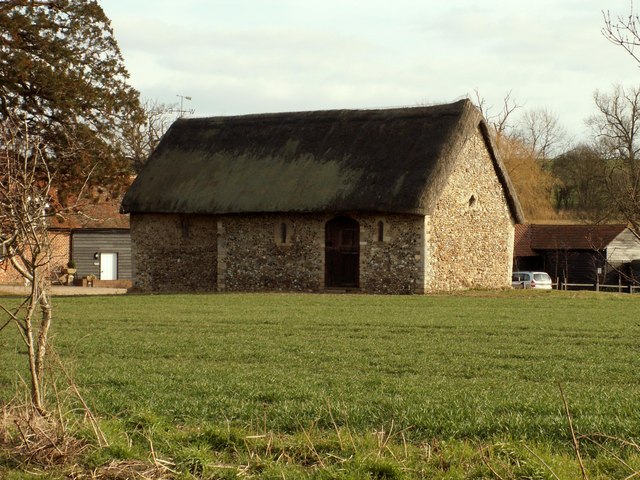
The Chapel of St. Helen on Bonhunt Farm
© Copyright Robert Edwards and licensed for reuse under this Creative Commons Licence.

About 1600 William Bradbury built a house on his property for his son Wymond, it was and is called The Brick House. On 24 June 1605, Wymond married, in London, at St. Michael’s church on Crooked Lane, the twice widowed Elizabeth Whitgift Cole Gill. Wymond’s brother Matthew was married to Jane Whitgift, her sister.

The Whitgift girls have an interesting ancestry which has been traced to Whitgift, Yorkshire, England. Elizabeth’s ancestor John Whitgift, Gentleman, is said to have established his sons in various careers.  His son Henry, Elizabeth’s grandfather, became a wealthy merchant in Great Grimsby, Yorkshire. Another son, Robert, found a career in the church and was the last abbot of the monastery of Wellow in Yorkshire which was dissolved by King Henry VIII in 1536. (8) Henry Whitgift married Ann Dynewell and had sons John, William, George, Phillip, Richard and Jeffery.(9)  

John Whitgift 
Henry’s eldest son John is said to have begun his education at Wellow Abbey and later attended Cambridge University. Like his Uncle William he chose a career in the church, not the Catholic Church of his uncle but the newly formed Protestant Church of England. He became an ordained minister and would rise through the ranks, eventually becoming the Archbishop of Canterbury in 1583. As Archbishop he would be the confessor to Queen Elizabeth I and was at her bedside when she died.  He also crowned her successor King James I.  John Whitgift never married and he shared the wealth he accumulated with his family, including Elizabeth Whitgift.

children of Wymond and Elizabeth
Wymond and Elizabeth had at least four children who were named on her tomb, they were:

1. Jane b. 1606 believed to have died in childhood(10)
2.William b. 1607 m. Mary Rogers, d. prior to 1650 (11)
3. Anne b. 1608/9 m. 1. Nicholas Troughton and 2. ____Stubbs, she was the executor of her father’s estate in 1651(12)
4. Thomas b. 1610 m. Mary Perkins, d. 1694/5 Salisbury, Massachusetts

thomas bradbury in england
Nothing much seems to be known about Thomas’ life prior to his emigration to New England. We do know that his mother died when he was quite a young child.  There is no indication that his father remarried, but that doesn’t rule it out.  His parents married in London and his father was living in London when he died, so it is entirely possible that Thomas too lived in London. It is also not known how or when Thomas met and became employed by Sir Ferdinando Gorges.

Gorges' signature
Gorges was a career soldier who was knighted for his service at the Siege of Rouen in 1591. He was the Governor of the Fort at Plymouth for many years. In 1606 King James I founded the Plymouth Company with the intent of establishing settlements in New England, Gorges became a shareholder in the company.   In 1622 he and John Mason were given an enormous land grant which they split between them.  Gorges’ half became the state of Maine.  Sir Ferdinando Gorges never traveled to New England but employed several men to act there as his agents. Thomas Bradbury was one of those men.

in america
Sir Ferdinando Gorges’ interest in New England seems to have been for financial gain and not religious fervor. Was that the same for Thomas? The first evidence of Thomas in York, Maine is a deed he wrote on 5 May 1636.(13) It is not known when or where he met Mary Perkins or when or where they married but, their first child was born 1 April 1637, so they were at least married by mid 1636.(13) It is probable that at least the first two of their children were born in York, Maine. By 1640 he was living in the Massachusetts Bay Colony in the newly founded plantation of Salisbury.

salisbury
On 13 May 1640, Thomas swore an oath and became a freeman of the Massachusetts Bay Colony. (14) In order to become a freeman, Thomas had to have been a member of the church. It would be interesting to know if he had previously been of the puritan persuasion, had he come to believe it or did he just recognize the need to belong to the church in order to get ahead. It is interesting to note that his Great Uncle, the Archbishop of Canterbury despised Puritans. In any event Thomas immediately became a  very active and important man in Salisbury and the Colony itself.  He was the town clerk and recorded some of their earliest documents.  He was a school teacher, soldier, justice of the peace, juryman, judge and county recorder.(15) He was known as Mr. Bradbury in deference to his status. In fact he seems to have been the ideal immigrant.

children of thomas and sarah

 1. Wymond b. 1 April 1637 prob. in York, Maine(16), m. 7 May 1661 Sarah Pike d/o Robert 
Pike, he   d. 7 April 1669 on the Island of Nevis, age 32.
 2. Judith b. 2 Oct 1638 prob. in York, Maine, m. 9 Nov 1665 Caleb Moody
 3. Thomas b. 20 Jan 1640/41 Salisbury, d. unmarried
 4. Mary b. 17 March 1642/43 Salisbury, m. 15 Dec 1663 John Stanyan of Hampton

 5. Jane b. 11 May 1645 Salisbury, m. 16 March 1667/68 Henry True in Hampton

 6. Jacob b. 17 June 1647 Salisbury, d. 1669 in Barbados age 22
 7. William b. 15 Sep 1649 Salisbury, m. 12 March 1671/72 Rebecca Wheelwright Maverick in  
Salisbury
 8. Elizabeth b. 7 Nov 1651 Salisbury, m. 12 May 1673 Rev. John Buss
 9. John b. 20 April 1654 Salisbury, d. unmarried 24 Nov 1678 age 24
10. Anne b. 16 April 1656 Salisbury, d. 1659 age 3
11. Jabez b. 27 June 1658 Salisbury, d. 28 April 1677 Salisbury age 19

As successful as Thomas and Mary were, they could not protect their children from the ravages of early death. Of their 11 children, six died by the time they were 32.  Two son died on islands in the Caribbean in the same year. Although this was not unusual for the time, it must have been extremely difficult to bear.

rip
Unlike some of their children Thomas and Mary both lived to a great old age. Thomas died first on 16 March 1694/5 at the age of 85.  Mary outlived him by five years and died on 20 Dec. 1700, she too was 85 years old at her death.

witch
I deliberately left out Mary's ordeal during the Salem Witch Trials as she is the subject of my first blog article, which I will like to once I have rewritten it. 

If you think I have anything wrong here, please let me know, in a nice way! Thank you for reading and please do not copy this article.

----------------------------------------------------------
(1) Bradbury, John M. Esq, "The Whitgift Bradbury Family", The New England Historical and Genealogical Register,  Vol. 23, 1869, p. 263.


(2)  ibid
Robert Charles Anderson and John B. Threlfall in their article, Ancestor Table for Thomas Bradbury, state that Thomas and Mary Perkins were married about 1636.  
(3) ibid


(4) Anderson, Robert Charles and Threfall, James B. “Ancestor Table for Thomas Bradbury of Agamenticus and Salisbury (1611-1695)”, The American Genealogist, Vol. 55, January 1979, p.2


(5) ibid, p. 3.


(6) Kirk, Marshall K. “A Probable Royal Descent for Thomas Bradbury of Salisbury, Massachusetts”, The New England Historic and Genealogical Register, Vol 161, 2007, p. 27-36


(7) "Local History of Wicken Bonhunt Village in Essex." Local History of Wicken Bonhunt Village in Essex. N.p., n.d. Web. 14 Feb. 2014.


(8) Rivington, J. G. and Rivington, F., Ecclesiastical Biography: Or lives of Eminent Men, Connected with the History of Religion in England from the commencement of the Reformation to the Revolution, Vol. 3, 1836, p.553


(9) Ibid


(10) Threlfall, John Brooks. The Ancestry of Thomas Bradbury (1611-1695) and His Wife Mary (Perkins) Bradbury (1615-1700) of Salisbury, Massachusetts. Madison, WI: J.B. Threlfall, 1988. Print.


(11) Ibid (there are no page numbers in this book)


(12) Ibid


(13) ibid


(14) Anderson, Robert Charles, George Freeman Sanborn, and Melinde Lutz. Sanborn. The Great Migration: Immigrants to New England, 1634-1635. Boston: New England Historic Genealogical Society, 1999. Print. Vol 1, A-B, p. 375-381


(15) Hoyt, David Webster. The Old Families of Salisbury and Amesbury, Massachusetts: With Some Related Families of Newbury, Haverhill, Ipswich, and Hampton, and of York County, Maine. Baltimore: Genealogical Pub., 1982. Print.p.70-72


(16) Ibid 14, Anderson says that on 13 May 1637 Thomas Bradbury and William Hooke wrote to Governor John Winthrop asking for a Minister for York, Maine.

--------------------------------

Learn how to cite your sources like a professional with Elizabeth Shown Mills Stripped Bare Guide to Citing Sources available at Amazon.com by clicking the link. 

--------------------------------

Roles of Men, Women and Children in 17th Century Puritan Massachusetts

In 17 th century pur itan Massachusetts , the roles of men , women and children were very clearly defined . Men were the ...