Tuesday, January 22, 2019

Blood In The Valley by Jean M. Roberts

I'm proud to announce the publication of my new (second) novel: BLOOD IN THE VALLEY, available on amazon.com in both Kindle and paperback versions. (If you have Kindle Unlimited it's free!) This book brings together my three passions: history, genealogy and writing. Let me tell you a little bit about the book. 

BLOOD IN THE VALLEY is based on the life of my ancestor Catherine Wasson Clyde and her husband Samuel Clyde. Catherine's grandparents, James and Catherine Thornton, immigrated in 1718 from Northern Ireland. They were part of the Scots-Irish immigration. The family settled first in Brunswick, Maine but were burnt out by the Natives. They spent a few years in Marblehead before settling in Worcester. The Puritans of Worcester were not amenable to Presbyterian worship  so James Thornton and several other men purchased land and founded their own settlement which was eventually named Pelham. James' son Matthew, born in Ireland, trained to become a doctor; he set up his practice in Londonderry, New Hampshire, home to a large Scots-Irish population. James eventually joined him in, living in Derry. 

Agnes Thornton Wasson and her husband John also migrated to New Hampshire; they settled in a town not far from Londonderry. In about 1754, Agnes and John, her brother William Thornton and his family, along with other Scots-Irish families left New Hampshire for the colony of New York. They arrived in Schenectady just as the last French and Indian war erupted. Following the war the family purchased land in Curries Bush, now Princetown. Catherine Wasson married Samuel Clyde and settled in idyllic Cherry Valley, on the edge of Indian territory. 

The book blends the history of the day with daily life in the 1700s. Few people realize that New York suffered the brunt of the battles during the American Revolution; more than one third of all major battles occurred in the Colony of New York, including some of the bloodiest. Catherine's husband, brothers, and her Thornton cousins fought in many of the major battles, including the Battle of Oriskany, a devastating fight that almost wiped out the fighting men of Tryon County. But this is not just the story of the men who fought, it's about their wives and children, and the plight they suffered through seven long years of war. 

The Cherry Valley Massacre marked a low point in the guerrilla warfare that was destroying the Mohawk Valley. Attacked repeatedly by Loyalist, Tories and their Indian allies, this area was savagely attacked year after year. The raiders employed a scorched-earth campaign that spared no one; not women, not children, nor the elderly. Farms were burnt to the ground, grain and livestock, stolen or destroyed. Thousands were either killed or taken as captives to Canada. Many were never seen or heard from again. 

This was the world of Catherine and Samuel Clyde and BLOOD IN THE VALLEY is there story. I hope you give it a read.

Don't forget, if you have Kindle Unlimited, it's free, for now! I have also enrolled my first book: WEAVE A WEB OF WITCHCRAFT,  about a couple accused of witchcraft in Springfield, Massachusetts in 1651, is also available for free on Kindle Unlimited. 

Tuesday, January 1, 2019

Mary Bliss Parsons: Accursed Name, Witch of Springfield, Massachusetts

Weave a Web of Witchcraft
In 1651 Mary and Hugh Parsons of Springfield were sent to Boston to stand trial on charges of Witchcraft, a hanging offense, long before the Salem trials. Mary died in prison shortly after her arrival. Accused of murder as well as witchcraft, her fate was sealed the minute she admitted to the crimes. Hugh fought his charges and despite being found guilty by the Court in Boston, the verdict was overturned and he was released from prison. He never returned to Springfield. You would think one witch was plenty for any small Massachusetts town, but not so for Springfield. Not only did it harbor a second witch, but her name was also Mary Parsons, what are the odds? 

Mary Bliss and Joseph Parsons
Mary, the daughter of Thomas and Margaret Bliss, was born in England around 1628. Her father was the son of Thomas Bliss of Belstone Parish in Devonshire, he immigrated to the New World and settled in Hartford, Connecticut. Mary married Joseph Parsons of Springfield on 2 November, 1646. 

Joseph Parsons was an ambitious successful man. In 1646 he was elected town surveyor of Springfield, still a small town;  in 1647 he was one of only 42 taxpayers (all men of course). He continued to fulfill his civic duty with increasingly more important jobs. By 1651, he was elected a selectman of the town. In 1655 he purchased land that would become the town of Northampton, to which the family removed shortly thereafter [1]

Discord
In the narrow world of Puritan Massachusetts, petty jealousies, slights, and insults fermented just below the surface. According to some, Mary Bliss Parsons was a strong woman who spoke her mind. When the Parsons moved to their new home of Northampton they were followed by other residents of Springfield, including Sarah and James Bridgeman. What seems to have started as idle gossip on the part of Sarah soon blossomed into something much more, accusations of witchcraft.

In the earlier  witchcraft case, Mary Parsons accused the widow Mercy Marshfield of witchcraft. Mercy sued her for slander and won. Hugh Parsons was forced to pay an enormous fine to settle the case. Likewise the growing rumor that Mary Bliss Parsons was a witch began to impact her life. Reputation was everything to these people and to be falsely accused of witchcraft was not to be borne. Joseph Parsons, on behalf of his wife, accused Sarah Bridgeman of slander. 

Slander Trial
Sarah Bridgeman and her neighbors were deposed in both Springfield and Northampton. Every manner of ill luck, sickness and misfortune was laid at the feet of Mary Bliss Parsons. There was testimony about yarn, pigs, sick children and a cow that was bitten by a rattlesnake. Counter testimony was given by supporters of the Parsons; Mary was an innocent victim falsely accused by vicious neighbors happy to see her get her comeuppance. [2] 

The local magistrate found in Mary's favor and on September the 8th Sarah was arrested. She traveled to Cambridge in October to stand trial. Sarah was found guilty of slander and just like Hugh Parsons, her husband was ordered to pay damages and court costs to the tune of £17 1s. 8d., quite a sum in those days. 

Witchcraft
Following the slander trial, life resumed its course but old wounds festered. In 1672 Robert Bartlett married Mary Bridgeman, daughter of Sarah and James. Sadly, the woman died within two years of marriage and the Bridgemans and Bartletts knew just who was at fault. The families again accused Mary Bliss Parsons of witchcraft. Once again, testimony was taken and anyone with a grudge against the Parsons had a ready tale to tell. Mary appeared before the court, ready to proclaim her innocence and face her accusers. Mary's body was searched, by her neighbors, for the mark of witch. Presumably none were found.

Mary was arrested and ordered to face trial.  In March she was sent to Boston to await her trial in prison. Her trial took place in May, before the Court of Assistants. Mary argued her own case and her testimony made a greater impact on her jury as she was freed, case dismissed. Her return to Northampton must have been bittersweet; she'd won, but she still had to live among her accusers. The stigma of her imprisonment and trial surely left a deep wound on this proud strong woman. 

Aftermath 
By 1679 Mary had borne twelve children, most of whom survived to adulthood. She and her family survived the devastating (1675-76) King Philip's War, which all but drove the English from their American Colonies. 45 of Springfield's 60 houses were burned to the ground and many residents killed. Scary times for nervous, superstitious, witch believing, devil behind every bush kind of people. Joseph purchased land in Springfield, after the war and moved the family back to Springfield. 

Joseph died in 1683. Mary lived a good long life dying in 1712. I wonder what her thoughts were on the 1692 Salem witchcraft trials, which resulted in the deaths of many innocent men and women. Did she feel sympathy for them? Did she believe for one minute that they might be guilty? Did she think on the witchcraft accusations of her namesake, Mary Parsons and wonder if she too might have been innocent? I hope so. 

Not a portrait of Mary Bliss Parsons

The Portrait
Apparently some folks have come to believe that the accompanying portrait is of Mary Bliss Parsons. This does not appear to be the case. See this blog for an explanation. 

More on Mary Bliss Parsons
See this excellent website from UMASS on Mary Parsons and her life and trial.  Includes digital copies of testimony, photos of her descendants homes, genealogies, etc. 


Sources

[1] Henry Parsons, Parsons Family; Descendants of Coronet Joseph Parson Springfield 1636...Northampton 1655, (New York: Frank Allaben Genealogical Company, 1912), Internet Archives (https://archive.org/details/parsonsfamilyde00parsgoog/page/n48 : accessed 1 January 2019).

[2] James Russell Trumbell, History of Northampton, Massachusetts Vol. 1, (Published in Northampton: 1898). Google Books (https://books.google.com/books?id=GNo_AQAAMAAJ&printsec=frontcover&dq=mary+bliss+parsons&hl=en&sa=X&ved=2ahUKEwic1tz368zfAhUO-6wKHaNZBi4Q6AEwA3oECAYQAg#v=onepage&q=mary%20bliss%20parsons&f=false : accessed 1 January 2019). 

Friday, December 14, 2018

Mary 'Molly' Brant; Hero and Villain of the American Revolution


Molly Brant and her brother Joseph were important characters in the Mohawk Valley of New York before and during the American Revolution. Today most Americans don't recognize their names, but in Canada they are remembered as heroes. Here is a little bit about her fascinating life.


parents
Mary's parent were christian Mohawks living in the Upper Castle, Canajoharie, on the south bank of the Mohawk River. The Native American towns were heavily fortified and the English referred to them as 'Castles.' Her birth year is estimated at 1736, her mother's name was Margaret Sahetagearat Onagsakearat. Her father's name cannot be confirmed but it is possible that she shared a father with her younger brother, Joseph. His father is known to have been Peter Tehowaghwengaraghkwin. The place of her birth is also unknown but has been speculated to have been in Canajoharie. At birth, Mary's Native name was Gonwatsijayenni, which means 'someone lends her a flower.' Later in life she went by Dagonwadonti, 'she against whom rival forces contend'. [1]As the Mohawk are a matrilineal society, children belong to their mother's clan, in this case Mary and Joseph were part of the Wolf Clan.

Peter died in the 1740's leaving Margaret destitute. She had a brief marriage at the end of the 1740's to a War Chief by the name of Lykus, but he was killed in May of 1750 in a raid. In September 1753 Margaret married the man who would lend Mary and Joseph their surname; Brant Kanagaradunka. Brant was a Mohawk sachem from the Turtle Clan, and he was wealthy. [2] Some sources claim that Margaret married Nickus Brant, the son of Brant Kanagaradunka. [3] Barbara Graymont says the stepfather was named Carrihogo, News-Carrier, known to the whites as Bernard, Barnet or Brant. [4] Most source seem to agree that Brant Kanagaradunka was Mary's stepfather. [5]

According to author Peggy Dymond Leavey, Brant built a large house for Margaret in Canajoharie, complete with glass windows and middle-class European furniture. [6] From this point on, Molly and Joseph had a foot in two worlds, their native culture and that of the New York Colony. Her step father and stepbrother Nickus, who one author described as a 'Chief.' had frequent interaction with William Johnson, Superintendent of Indian Affairs, a frequent visitor to Canajoharie. His Native name was Warraghiyageh, "he who does much business'. [7]

middle years

In 1759, 23 year old Molly began a relationship with the much older Sir William Johnson. He his wife, Catherine, had died. It is rumored he married her on her deathbed to legitimize his children by her. There is no proof of an English marriage between William and Molly, but it is possible they had a traditional Mohawk ceremony. In any case she moved into his home, Fort Johnson, and took the running of his household. She was sometime's referred to as the 'Brown Mrs. Johnson'.


Molly gave birth to at least eight children. Sir William eventually built a larger house to show off his status and accommodate his large, and growing family. [8] Together they entertained the leaders of both the Iroquois Confederacy the English Colonies, political, military as well as businessmen. Her home was open to any and all and she and Sir William entertained constantly. In 1763 they moved into the larger, grander Johnson Hall. John Johnson, Sir Williams legitimate son and heir took over Fort Johnson. 

Sir William passed away in 1774. In a way, his death symbolized the death knell of English rule in America.  Already the seeds of revolution were germinating in the thirteen colonies. Molly relinquished control of Johnson's estate to his eldest son and heir, Sir John Johnson and moved with her children to Canajoharie.

american revolution
The American Revolution brought an end to the thousand year old Iroquois Confederacy, splintering the tribes. The Mohawks choose the side of the King. From her home in Canajoharie, Molly kept an eye on the rebel movements. In October 1777 she gave warning to the British of the approach of an American force resulting in the Battle of Oriskany. A band of Oneida's, burnt her house to the ground in retribution. She fled for the safety of the Cayugas, eventually making her way to Fort Niagara. [9]
Molly supported the efforts of her brother Joseph, who lead a group of white Tories and Mohawks. She eventually landed at Carleton Island for the duration of the war, trying to broker peace between unhappy Mohawks and the English.

After the war she was awarded a pension from the crown and settled in Kingston, Ontario, on the mainland. Today, Carleton Island is part of the United States. Five of her daughters married Canadians. She had one son who survived, George, who worked for the Indian Department.

rip
Molly lived in Kingston for the rest of her life. She died in 1796. Sir William's heir attempted to reclaim their lost American property, to no avail.

Blood in the Valley
Blood in the Valley is my next book, in its final editing stages, it should be available Spring 2019. Molly and her brother feature in this novel set before and during the American Revolution. UPDATE: It has been released! Get it now on Amazon.

Sources:

[1] Peggy Dymond Leavey, Molly Brant: Mohawk Loyalist and Diplomat, (Toronto: Dundurn, 2015).


[2] Isabel Thompson Kelsay, Joseph Brant, 1743-1807, Man of Two Worlds, Syracuse, New York: Syracuse University Press.

[3] Marshall, George L, Jr., Chief Joseph Brant: Mohawk, Loyalist, and Freemason: http://www.earlyamerica.com/review/1998/brant.html

[4] Barbara Graymont, “THAYENDANEGEA,” in Dictionary of Canadian Biography, vol. 5, University of Toronto/Université Laval, 2003–, accessed December 13 2018.

[5] James Taylor Carson, "Molly Brant, From Clan Mother to Loyalist Chief," Sifters: Native American Women's Lives, 


[6] Peggy Dymond Leavey, Molly Brant: Mohawk Loyalist and Diplomat, (Toronto: Dundurn, 2015).


[7] Leavey, Molly Brant.

[8] The Editor of the Encyclopedia Britannica, "Mary Brant", Encyclopedia Britannica (https://www.britannica.com/biography/Mary-Brant : accessed 13 December 2018).

[9] Carson, Molly Brant.

Wednesday, November 21, 2018

1718 Scots-Irish Migration: From Londonderry, Ireland to Boston, Massachusetts

If you are interested in early colonial American history then you know of the phenomenon called the Puritan Great Migration which began in 1630 and lasted for 15-20 years. But less than one hundred years later there was a second smaller migration from the North of Ireland that has been labeled the 1718 Migration. The people who made up this migratory group were Scots-Irish or Ulster-Scots as they are called in Ireland today. This year (2018) marked the 300th anniversary of their voyage to America. This fascinating phase in the peopling of America is understudied and deserves more attention. There is a great facebook page dedicated to the 1718 Migration which I have found very helpful. There is also a familytreedna project trying to connect descendants of those immigrants to their ancestral origins in Ireland and Scotland. Long time blogger Heather Wilkinson Rojo has profiles on many of the early Londonderry (Nutfield) on her blog a must read.

I've only recently become interested in this integral piece of my family history, hopefully you'll catch the bug as well. 

Scottish Origins
The Scots-Irish/Ulster Scots, as their name implies, have their origins in Scotland. A large number of Scottish immigrants arrived in the Northern counties of Ireland during the plantation schemes, from 1607 until 1697. The plantations were limited to the counties of Antrim, Down, Armagh, Tyrone, Donegal, Cavan, Fermanagh and Derry. The purpose of the scheme, organized and fully supported by the Crown, was to fill the North of Ireland with loyal subjects. Most those who left the mainland were from Scotland but there were also English immigrants from the north of England. Scotland was only happy to rid itself of the marauding lowland border inhabitants, know as reivers.

Unsettled Times
By the late 1690s many of the Scots-Irish settlers were unhappy with life in Ireland. Most were excluded  from many aspects of government and civic duties. They were being hampered in their religious life as well. Many had leases that were about to expire and faced significantly higher rents, a process known as rack-renting. The economy was weak and the British controlled export prices, the export of woolen and linen items was hampered by the Irish parliament.The Woolens Act prohibited the exportation of Irish wool and cloth to anywhere except England and Wales. To top it all off the weather lead to crop failures. A five year drought from 1714 to 1719 led to crop failures. This affected both the food supply but also the supply of flax for linen production.

Massachusetts
 A letter, drafted in Ireland and signed by eight Presbyterian ministers and 319 men was sent to Governor Shute. The letter was a request to settle in the Colony. The letter was sent with Reverend Boyd, however the immigrants did not wait for a reply. The Reverend James McGregor organized about 120 families from Antrim and Londonderry and set sail from Derry and Belfast for America. They arrived in four or five ships between August and September of 1718.

Massachusetts was still a Puritan stronghold in 1718. But, they had a slight problem, the Native population continued to threatened their borders. The immigrants were not overwhelmingly welcomed and were dispatched immediately to distant settlements in New Hampshire, Maine and Massachusetts, where they could act as a barrier between Indian territory and the settled areas of Massachusetts of which Maine was still a part. The ship the Robert sailed for Casco Bay in Maine, its passengers forced to winter aboard the ship.

My Ancestors
My 1718 Migration ancestors were the Thornton family who are said to be from the Strabane Valley of County Tyrone. We know that James Thornton said his father William was born in Tyrone County. William was born in 1713, son of James Thornton. There is a manuscript in the New York archives, which I have not read, which says the Thorntons were in Londonderry, Ireland during the seige, but little else. Many people believe that the Thorntons originated in Yorkshire, England, which would preclude them from being Scottish.

The Thornton Family arrived in Boston, probably on the ship the McCallum. They were part of the group who headed to Maine, first to Merrymeeting Bay and then closer to Bunswick. James had a homestead in Brunswick, Maine on the Rossmore Road. This home was consequentially burned by Natives in June of 1722. The family was forced to flee. I believe they found refuge in Marblehead.

There is a baptismal record for Hannah and Sarah Thornton in Marblehead in 1726. There is no further record of James and Catherine Thornton in Marblehead, so I believe that this is a record of their known daughter Hannah and unknown daughter Sarah.

James, along with other Marblehead Scots-Irish removed to Worcester, Massachusetts in the late 1720s. James bought and sold land, was listed in the meeting house seating records along with his two sons William, my ancestor, and Matthew, the signer of the Declaration of Independence. Worcester was not as welcoming to the Scots-Irish as they had hoped, and after some years, James and others purchased land for their own town of Lisburn/Pelham. James ended his years in the Scots-Irish stronghold of Derry.

Sources:

Bolton, C. Knowles. (1910). Scotch Irish pioneers in Ulster and America. Boston: Bacon and Brown.

Parker, E. L. 1785-1850. (1851). The history of Londonderry, comprising the towns of Derry and Londonderry, N. H.. Boston: Perkins and Whipple.

Dickson, R. J. (1966). Ulster emigration to colonial America, 1718-1775. London: Routledge & Kegan Paul.

Lunney, Linde. "The 1718 Migration." North Irish Roots 22, no. 1 (2011): 18-25. http://www.jstor.org/stable/23056676.

Nutfield Genealogy


Thursday, September 13, 2018

Martha Ann Morris Knuff (1869-1935) From Canada to Los Angeles: Is she your ancestor?

This is the second batch of photos that were recently found in a resale shop. This beauty is Martha Ann Morris aged about 16 according to the writing on the back of the photo. She was born in Canada on in 1869. On 28 January 1891 she married Angus Knuff. Agnes and Martha can be found on the Canadian census for Battleford, Saskatchewan for many years. In 1930 Martha was living in Los Angeles with her daughter, Loretta Moore. Both she and Angus applied for Social Security in the United States. Martha died on 12 April 1935 and is buried in Los Angeles. Angus died in 1951 and is buried in Canada. These photos were part of collection that included the Jennison Family of Mason City, Iowa who also moved to L.A.


According to a second photo, Martha Ann was raised by her grandparents and later became a 'mothers helper for a family named Morrison. Pictured below. However there is an ancestry tree which lists her parents as Matthew Morris and Emma Hutchinson. Both of these names are on the back of this photo. I suspect that these folks are her parents.


Here is a photo of two of Martha's children Loretta Alberta and 'Fernie'. The dog is not named.


Are these your ancestors or people in your tree? Would you like these photos? Send me a message with your name and address. What I ask in return is a donation of $10.00 to cover the cost of mailing envelop and postage and a bit of my time or....you can buy a copy of my book. Either way, please contact me and I will be happy to get them in the mail.

Wednesday, September 12, 2018

Horton Clark Jennison (1847-1939) son of George Henry Jennison of Swanton, Vermont: Is this your family?

Horton Clark Jennison
Taking a break from my second novel to post some pictures that were donated to a resale shop. This handsome man is Horton Clark Jennison. He was born on 24 March 1874 in Mason City, Iowa. Mason City is due north of Des Moines, and sorry Iowa but it appears to be in the middle of nowhere.  Sorry just sayin. Anyway Horton's parents were George Henry Jennison and Addie Mary Potter, originally from Swanton, Vermont. According to an ancestry tree George Henry was the son of Nahum Eager Jennison (no that's not a typo). Nahum Eager was a minute man in Massachusetts, probably a friend or hero to the parents. In fact I just found a reference for a Israel Jennison whose married daughter was Sarah Eager, so it seems they were related. 

If this ancestry is correct, which at first glance seems plausible. Nahum was born on 24 April 1793 in Worcester, MA, he died 8 August 1849 in Swanton, Vermont. Swanton is just shy of the Canadian border. Nahum married Betsy Hubbard in Swanton on 5 January 1824 and had at least nine children, George Henry coming at the end. George married Addie Mary Potter of St. Albans. At some time after their marriage the couple moved to Mason City, Iowa. 


Horton, who was a clerk in a store,  married Anna Hutchins on 8 June 1910 in Cerro County, Iowa. In 1916 Horton and his family were living in Los Angeles, California, working as a clerk. His sister Addie Lou Jennison Hathaway and her husband Earl had also removed to California. Below is one of two pictures of Horton and his fellow employees. 


Horton is second from left, top row

This is a picture of Addie Lou Jennison Hathaway, Lou was Horton's sister. On the back it say's it was taken about 1910.


So, do you know these folk? More importantly do you want these photos? If so, please contact me with your mailing address. What I ask in return is one of two things: $10.00 via the donate button above to cover the cost of photo mailing envelop, postage and my time or buy my book, the digital version is  under $10.00. 

Saturday, July 28, 2018

History and Genealogy Tour of the Mohawk Valley: Summer 2018

The Stockade
The oldest part of Schenectady, New York is known as the Stockade. This designated area was once inside, you guessed it, a stockade. It is made up of half dozen streets that all seem to lead to the banks of the Mohawk river. They are peppered with 18th century houses, churches, graveyards and other buildings. The oldest surviving house was built in 1742. Many of the houses have historical significance for both the state of New York and the American Revolution. Despite this, it is not a touristy area. I think I was the only person trouping around with a camera. The houses are almost exclusively private homes. 

We stayed in a charming little hotel called The Stockade Inn. It's not a chain, has only a dozen or so rooms and was a few minutes from the river. It was full of historical photos of old Schenectady and was once a 'Men's Club'. It proved to be a great place to crash at night after a day of sightseeing. There are several really good restaurants within walking distance as well. 

We visited the Schenectady Historical Museum which was really nice. It had a lot of interesting information about the founding and evolution of the city. Well worth stopping by. 

Fort Ticonderoga 
The drive to Fort Ticonderoga was a mixed bag; half interstate, half winding road along the shore of  Lake George. An interstate is an interstate, but the drive long the lake was lovely; once we got away from the touristy bits. The Village of Lake George was slammed with people and is chock-a-block with restaurants, gift shops, putt-putt golf, cute motels and camps along the river. It looks like a great family friendly town, but it was very crowded. We were there on a Tuesday, can't imagine what the weekend is like. 

At the very end of Lake George is a recreation of Fort William Henry, made famous in the movie, The Last of the Mahicans. My husband described it as 'Disneyesque' and it was not worth our time.  It was great for small to medium sized children, but not so much for the serious history buff. 

Fort Ticonderoga sits all by itself on Lake Champlain. Vermont, the state, is just across the lake. The views from the ramparts are amazing. The fort was mostly reconstructed in the early 1900s but if you did not know it you might not guess. The museum rooms are full of artifacts and history. When we went there were a few reenactors but not too many. 

The day was cloudy with a slight drizzle, the low hanging clouds added to the mystery of the place. A plaque at the Sally Port lists all the amazing people who passed through the gates from Ethan Allen and his Green Mountain Boys to Benedict Arnold. It was really quite wonderful to be there. After a tour of the fort we drove up to the top of Mount Defiance, where the canny British dragged their cannons, forcing the surrender of the Fort in 1777. What a spectacular view of the surrounding area. 

What really struck me though, and this would be a common theme throughout our trip, there was almost no one there. Maybe thirty people at this huge historical site, so important to our county's history.  It made for a nicer experience for us, having the place to ourselves but, wow, just wow. 


The Van Alstyne House, Canajoharie
The Van Alystne House is a rare gem in the small town of Canajoharie. It was built in stages by Martin Van Alstyne, the oldest portion dates to around 1730. It started life as a one room house for Martin, his wife and their children. By the time of the American Revolution it belonged to Goshen Van Alstyne and had multiple rooms. It was not only the Van Alstyne family home but  a tavern. This was the site of many, if not most, of the meetings of the Tryon County Committee of Safety.  

The museum/house is well maintained and holds many historical treasures, including a 17th century bible. There are  documents from the time of the revolution and a collection of paintings and documents belonging to Rufus Grider, a teacher/ historian who documented life in the Mohawk Valley. 

The house is only scheduled to open on Saturdays, but we were given a private tour, on request. Our tour guide Shirley was highly knowledgeable on the history of the house and the part it played in our collective history. It was well worth the visit. The house host reenactments during the summer season, has it's own Facebook page and is on twitter: @VahsCanjo. 

Cherry Valley
The town/village of Cherry Valley is a quiet peaceful farming community with a violent history. During the American Revolution combined Loyalist and Native American forces descended on the tiny settlement and killed, butchered really, anyone they could get their hands on, including several families with Loyalist standings. Hundreds more were taken captive. Despite the presence of a fort, the naive commander, Colonel Alden spread his troops across the valley, most  were killed, including himself. Every building in the valley was torched. 

There is a small historical museum in town with artifacts from the original inhabitants. It's small but worth stopping into. The well maintained cemetery has a monument to those who were killed during the massacre, the fallen Col. Alden and is the final resting place of those who fought during the revolution. The drive to Cherry Valley is beautiful, the roads winding their way up and down the hills.  There's not much else there historically but it's  nice stop. 

Cooperstown
All I can say it was crazy packed with people. We did a quick walk through the packed baseball hall of fame and then boogied. 

Herkimer House
The home of hero Nicolas Herkimer was the first of three historical homes we toured on the same day. We arrived just about 10:00am. There were two other people there. The house is located outside of the town of Little Falls. The grounds are large and the setting is lovely. The Georgian house is in fantastic condition and beautifully furnished, including some items original to the house. We  had a great tour, our guide was well versed in the history of the house and the life of Nicholas Herkimer. After viewing the house we visited the graveyard which has a very large monument dedicated to Nicholas Herkimer.  The visitors center has many interesting displays and is worth walking through.  When we left we were the only visitors there. 

Indian Castle Church
This is a tiny church built in 1769 for the Indians of  the Mohawk Castle whose inhabitants included Joseph Brant and his sister Molly Brant. The church has been restored following a fire and is in amazing condition. I was surprised to find the door unlocked and we were able to see the inside. We were the only people there. The church sits on a small hill off with a dirt drive. If you're not looking for it you'll drive right past. It a nice example of 18th century Colonial buildings, and worth a stop.


Johnson Hall
Johnson Hall is in the town of Johnstown. It was the third and final home of Sir William Johnson, hero of the French and Indian Wars and Superintendent of Indian Affairs until the time of his death in 1774. He was a very colorful character who lived a robust adventurous life. His second 'wife' was the Native American woman, Molly Brant. Sir William was the richest man in the Mohawk Valley and his home reflects this. It is full of period, some original, furniture and is full of history. The tour was fantastic and the guide highly knowledgeable. There were three of us on the tour.  


Old Fort Johnson
This was the second home of Sir William Johnson, built with his first flush of wealth. He designed the Georgian style house himself and the dimension reflect the lack of an architect, but he did a pretty good job.  He lived here with his first 'wife' a runaway indentured servant. The house can be toured and is okay condition. It could use a bit of restoration, but is still well worth a visit. The grounds are pretty and there is a small museum/bookshop and a video presentation on the house. Again there were three of us on the tour. 

We had only four days to pack in a lot of sightseeing. The Mohawk Valley is full of historical sites that we were unable to squeeze in. As much as I enjoyed my practically one on one tours at this significant historical sights, it saddens  me that there is such a lack of interest in them. These places cost a fortune to preserve and if no one comes to visit we may lose them. So get off yer duff and go visit a historical site! 

See this Facebook page for things to do. Colonial Families of Tryon County  

If I'd had another day, I'd have gone to Fort Plain.

Great book on the Mohawk Valley during both the French and Indian War and the American Revolution. The Bloody Mohawk. I read and re-read this book. 

I am in the process of writing my second book, Blood in the Valley, set in Cherry Valley during the massacre. While you eagerly await it publishing, big grin, you can read my first novel, Weave a Web of Witchcraft, set in Puritan Massachusetts. It tells the true story of Hugh and Mary Parsons of  Springfield, both of whom were accused of witchcraft. 
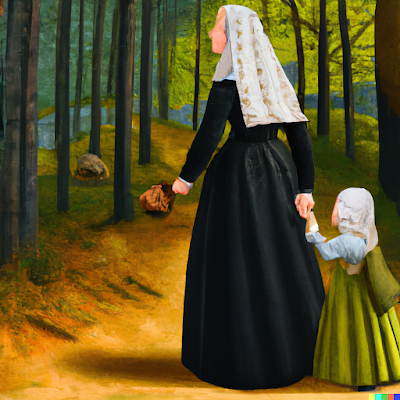
Roles of Men, Women and Children in 17th Century Puritan Massachusetts

In 17 th century pur itan Massachusetts , the roles of men , women and children were very clearly defined . Men were the ...